




Is skydiving really that dangerous?
About fear, numbers, and reality
Last updated: 12 March 2026
The bottom line:
For many people, skydiving instantly means danger and newspaper headlines. But if you look past the sensational stories, you’ll see a sport that is, in practice, highly controlled and carefully organized. In this blog we look at the image, the actual risk, and what has changed over the years to make skydiving as safe as possible.
- Skydiving has an intense image, but serious accidents are rare compared to the number of jumps.
- The biggest risks are usually not the equipment, but human behavior and slipping on procedures.
- Modern gear, serious training, and a strong safety culture keep risks small, especially if you stay sharp and aware yourself.
- If you want hard numbers, you can find official statistics via the KNVvL and international skydiving federations.
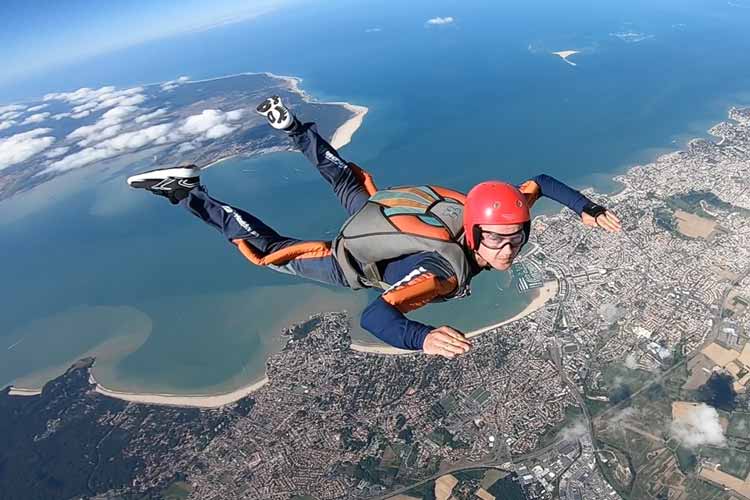
A well trained skydiver in stable freefall. Skydiving is less reckless than it looks.
Why skydiving has such a heavy image
The moment the word skydiving comes up, many people automatically think of risk. The picture is clear: people jumping out of an aircraft, that must be life threatening. And when something goes wrong, you’ll see the predictable headline: “Parachute didn’t open.”
What those articles almost never explain is what actually happened. In most cases, it isn’t equipment that suddenly fails. It’s human decisions: misjudging a situation, dropping procedures, or making the wrong call at the wrong time. That nuance doesn’t make for a dramatic headline, so the image sticks, while everyday reality is a lot more grounded.
Compare it to driving
Anything outside our comfort zone quickly feels dangerous. At the same time, we get into a car, on a bike, or on a plane without thinking twice. We call that “normal” because we do it every day, even though that’s exactly where a lot of accidents happen.
In the early 1970s, annual traffic fatalities in the Netherlands were around 3,200. Thanks to better rules, safer infrastructure, and technology like seat belts, helmet laws, and speed cameras, that number dropped significantly. In 2023 there were still 684 traffic deaths. That is still a shocking number considering how routine driving feels to most of us.
Skydiving sits in a completely different scale. Worldwide, millions of jumps are made every year and serious accidents are the exception. It feels intense because it’s far outside everyday life, but if you look at the number of jumps versus the number of incidents, the risk is much smaller than most people assume.
Official numbers and statistics
Maybe you’re the kind of person who simply wants the bottom line: what is the risk, really? It’s good to know there are hard numbers. National and international federations track how many jumps are made and which incidents occur.
On parachute.nl, the website of the KNVvL skydiving section, you’ll find extensive information about training, licenses, and safety policy in the Netherlands. If you specifically want numbers about jump volume, incidents, and training, have a look at the technical annual report.
International organizations also publish incident reports and statistics, for example on the USPA safety page.
What you’ll see there is that serious accidents are very rare compared to the total number of jumps, especially within recognized clubs and training centers. In this blog we stick to the big picture. You don’t need to memorize tables to make a smart, safe decision. More important is understanding which factors truly make the difference.
Skydiving is safer than ever
The sport has evolved massively over the last decades. Modern parachute systems are robust, reliable, and built with redundancy: you always jump with a main canopy and a reserve canopy. On top of that, an automatic activation device (AAD) can intervene if you don’t deploy in time.
Training has also become far more professional and structured. During an AFF course you learn step by step how to handle your equipment, deal with emergencies, and manage your own stress. You don’t “just join once”. You are trained to make conscious decisions in the air.
Curious where that system came from and why AFF is built so logically? Then read how the AFF training program was created.
At Airboss we use approved equipment only, maintained under strict protocols. Our instructors are certified, jump a lot, and keep training consistently. Airboss is connected to the KNVvL and operates within the applicable regulations. That means periodic inspections, documented procedures, and a safety mindset that is present throughout the organization.
Want to know more about how our equipment works and how it is maintained? Read the blog “Equipment safety”.
The most important factor is you
No matter how safe skydiving has become, one thing never changes: you are the key link. Just like in traffic, paying attention matters. Not trying to be “cool”, but staying smart. Following procedures. Being willing to discuss mistakes, with yourself and with others.
That mindset is what makes the difference. Skydivers are often extra aware of safety. Not because they are scared, but because they understand responsibility. The more you learn, the clearer it becomes that safety is not luck. It is the result of a long chain of good decisions.
So if you train with us, it’s not only about body position, altitude checks, and landings. It’s also about your mindset. If you learn to stay calm under pressure, ask questions, and do your checks consistently, you carry that into every jump and, honestly, into the rest of your life too.
If your main question after reading this is simply: how do I start safely? Then read How do I start skydiving?.
More about safety and mindset
- ➔ Skydiving and stress: how to stay calm when everything is moving.
- ➔ The psychology of skydiving: what freefall teaches you about yourself.
- ➔ Fear of heights and still learning to skydive?: why fear does not mean you cannot do it.
Want to explore more about skydiving, training, and trips?
Check our Airboss homepage for all options.
“It’s not the risk, but our fear that decides what we dare.”
Skydiving helps you break through that.