




Skydiving and stress: how do you handle it?
Last updated: 9 December 2025
The bottom line:
Stress is part of skydiving and that is okay. In this blog you will read how tension works, how to deal with it and why that first jump becomes not only a physical achievement, but also a mental victory.
- Stress when skydiving is normal. Your body reacts instinctively and that is okay.
- With breathing, focus and guidance you can learn to handle the tension in the aircraft.
- Every jump is also a mental exercise. Skydiving helps you grow, inside and out.
Stress is normal, even in the aircraft
Skydiving is exciting. Full stop. Your body reacts instinctively: a higher heart rate, a dry mouth, tingling hands. For many people it is the first time they feel their stress response this raw and unfiltered.
But that does not mean something is wrong. Stress is not your enemy. It is information. And especially during an AFF course or A licence course you learn how to work with that tension instead of fighting it.
Skydiving as mental training
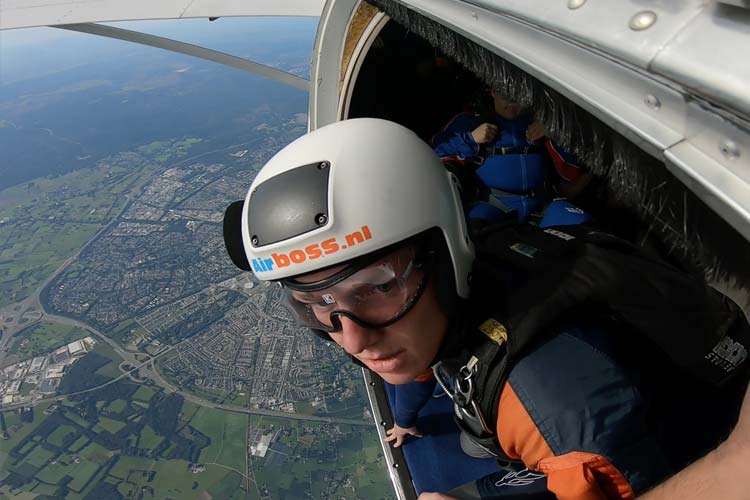
Every jump is an exercise in focus, breathing and letting go. The moment you sit on the floor of the aircraft waiting and the door opens is both the most intense and the most educational moment of the day.
Skydiving shows you how powerful your mind is, but also how important it is to let that mind go for a moment. Thinking does not keep you in the air. Trust does.
Checklist: how to deal with stress when skydiving
- Breathe consciously: in through your nose, slowly out through your mouth. Do this a few times before you move towards the door. It calms your nervous system.
- Focus on the process: do not think about “the jump”, but about the steps you have to take. What is the sequence? What did you practise?
- Visualise your jump: briefly close your eyes and see yourself exiting in a stable position. Repeat this in your mind, it really helps.
- Set an intention: tell yourself what you want to get out of the jump. “I want to learn to trust.” Or: “I am allowed to be nervous and enjoy this at the same time.”
- Move your body: walk around for a bit, shake out your arms. Stress also sits in your muscles.
- Be kind to yourself: tension is part of it. Even experienced skydivers feel it. There is no right or wrong way to feel before a jump.
Talk about it, do not let stress grow in silence
If you feel tense before a jump, say so. To your instructor, to your buddy, to yourself. You do not have to act tough. By being open, you create space for guidance, breathing, humour and eventually trust.
Many people think they are the only one who is afraid. Nothing could be further from the truth. Some grew up with the idea that you should not show vulnerability, that you just have to push through without complaining. But skydiving is not a battle. It is a journey. And you do not make that journey alone.
At Airboss we encourage you to bring everything you feel. Not to push it away, but to use it. So your jump does not only become a physical experience, but also a mental victory.
After landing: everything falls into place
The first jump is often life changing. Not because you jumped out of an aircraft, but because you went through it, straight through the fear. And you take that feeling with you. In your body, in your mind, in your life.
Skydiving with awareness
At Airboss we do not only work on your skills in the sky, but also on what happens inside. Our approach is personal, mindful and goal oriented. And there is always room for who you are, stress or no stress.
Especially during our Ground Control retreat in Royan we combine AFF with mental growth, reflection and relaxation. Because skydiving starts with daring, but it is about much more than that.
Ready for your next step?
More inspiration for your skydiving journey
- ➔ Skydiving with fear of heights: overcome your fear and discover new freedom.
- ➔ Your first skydive: from hesitation to euphoria.
- ➔ Wind tunnel training: progress faster in the air.
Want to discover more about skydiving, courses and holidays?
Have a look at our Airboss homepage for all options.
“Courage is not what you feel when the fear disappears, but what you do while it is still there.”