




How the AFF training program was created
and why you benefit from it today
The bottom line:
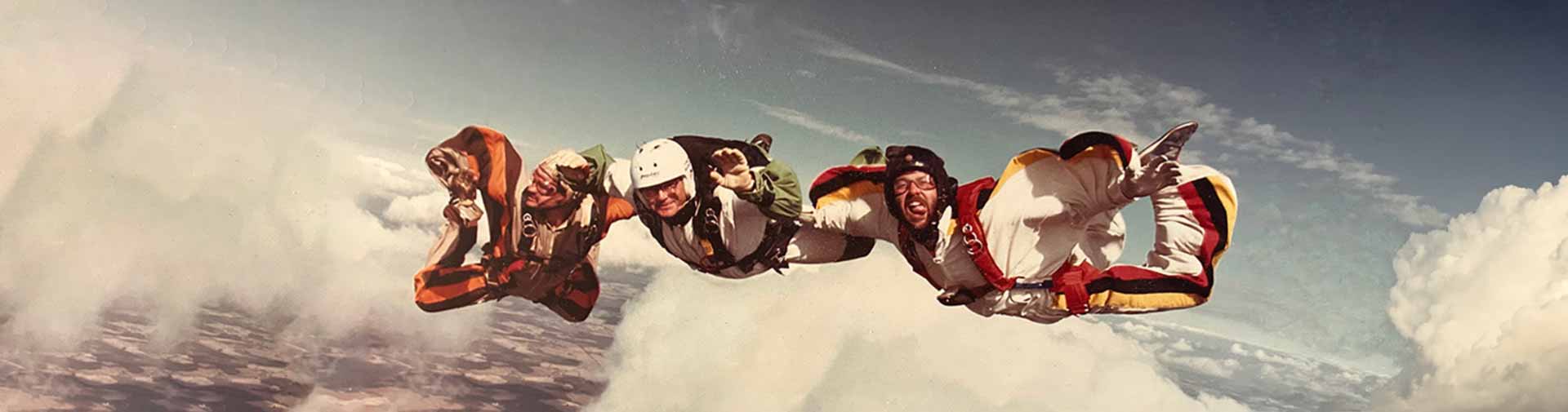
Accelerated Freefall, or AFF, is not just a name for a course. The system grew out of experiments by a group of instructors in the United States who believed students should experience real skydiving right away. Not “getting used to it” with a quick deployment first, but learning to fly from jump one. What started as an idea from a handful of pioneers became a global training system. The AFF training you do with Airboss today sits on top of that history of testing, improving, and building experience.
- Before AFF, beginners mostly learned through static line jumping.
- In the late 1970s, instructors in the United States explored training students directly in freefall.
- In 1981, Accelerated Freefall was officially recognized by the US skydiving association.
- From the 1980s onward, AFF spread across Europe and later to the Netherlands as well.
- The training you do today is the result of decades of experience and refinement.
AFF in short: what makes it different?
If you’re thinking about learning to skydive today, AFF can feel almost obvious. You exit the aircraft from full altitude on jump one, have instructors right next to you, and you learn step by step how to control your freefall. But it wasn’t always like that.
For decades, beginners learned through static line. You typically jumped from around 3,500 ft (about 1,000 meters) and your parachute opened almost immediately. Freefall came later in the progression. For many students, that transition felt big, sometimes even like being thrown into the deep end all at once.
AFF flips that approach. You start with freefall, from about 13,000 ft (roughly 4,000 meters). Instead of a short jump with an immediate canopy, you get time to feel what’s happening, follow instructions, and build control. Instructors fly alongside you, help you stay stable, and give signals for body position and exercises. After a series of coached jumps, you work toward your first real solo.
Want to understand that “body position and flying” feeling better without stepping into the aircraft right away? Then wind tunnel training for skydiving is a solid, practical add-on.
If you’re still right at the start and want to understand how the whole path works, how to start skydiving is a good next step.
The idea behind AFF is simple. If you want to learn skydiving, the best way is to experience what skydiving really is from the beginning.
How AFF started in the United States
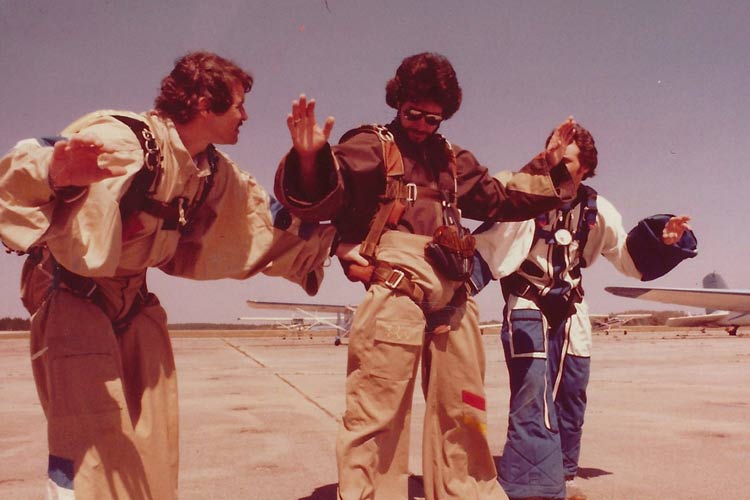
To understand where AFF came from, we have to go back to the United States in the 1970s. Skydiving was already an established sport, but training was almost always done via static line. Freefall was still mostly for experienced jumpers.
A group of instructors believed it could be done differently. One name that keeps coming up in the history of AFF is
Ken Coleman.
He proposed training students directly in freefall, with instructors guiding them in the air.
Source: International Skydiving Museum & Hall of Fame, Ken Coleman.
The idea was simple, but also bold. Instead of sending a student out alone and introducing freefall later, instructors would fly next to the student and stabilize them when needed. That way, someone could learn what freefall really is from the very first jump.
And yes, if you’re hearing this for the first time, you might think: “Wait… is that actually allowed?” Questions like that often come from misconceptions about how training programs are built. If you run into that, read the biggest misconceptions about skydiving. It clears up a lot.
The pioneers behind AFF
The first experiments took place in the late 1970s at Skydive DeLand in Florida. Ken Coleman worked there with a small group of highly experienced jumpers, including Gary Dupuis, Hoot Gibson, Rocky Evans, and Mike Johnston.
They developed a training program with multiple levels. In the first jumps, two instructors coached the student in freefall. Later that became one instructor, and eventually the student jumped independently.
The first test series started around 1979. Instructors literally held the student by the harness during exit and stabilization, and used hand signals in the air for body position, altitude awareness, and procedures. It turned out to be surprisingly effective. Students learned control faster and gained confidence in freefall much earlier.
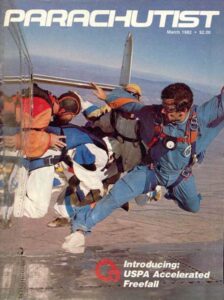
In 1981, the Accelerated Freefall program was officially approved by the US skydiving association (USPA). Ironically, Ken Coleman didn’t live to see that moment. He died shortly before, in a balloon accident. His work, however, became the foundation for the training system that’s now used worldwide.
The 1980s: AFF goes global
Once AFF was officially recognized, the system spread quickly. Instructors from different countries traveled to American dropzones to learn the method and then brought it back to their own training centers.
That timing was no coincidence. In the same era, the sport itself took a major technological leap. Round parachutes were increasingly replaced by steerable ram-air canopies. The three-ring system made cutting away a main canopy more reliable, and automatic activation devices became more widely and professionally used.
These developments gave instructors the confidence to train students in freefall earlier. AFF fit perfectly with the rise of modern sport skydiving.
How AFF reached Europe
Europe watched this new approach with interest. In the 1980s, instructors in countries like the United Kingdom and Spain started the first AFF programs.
International dropzones such as Empuriabrava in Spain played an important role. Skydivers from many different countries met there, exchanged techniques, and took new ideas back home.
Slowly, a similar training structure emerged in Europe as in the United States. AFF became a second training route alongside static line. For motivated students who wanted to immerse themselves and progress fast, AFF increasingly became the logical choice.
The first AFF programs in the Netherlands
Skydiving has existed in the Netherlands for decades as well. Through the KNVvL and various parachute centers, people learned via static line. Freefall here also typically came later in the progression.
Developments from the United States carried across the ocean. Within skydiven Nederland, AFF also started to find its place during the 1980s.
In the 1980s, Dutch instructors began getting familiar with the AFF system. At first, both training methods existed side by side. Static line remained a trusted route, while AFF offered a faster path to freefall and independent jumping.
In the years that followed, the program was refined further. Procedures became tighter, equipment more reliable, and instructor training more professional. By the 1990s, AFF had become an important training route at many dropzones for motivated students who wanted to learn to jump independently.
From pioneers to your training with Airboss
So what does this history have to do with your jump, years later on a strip in France or at the foot of the Atlas Mountains? More than you might think.
The AFF training you do with Airboss follows directly from the programs developed in the 1980s and refined ever since. You jump from about 13,000 ft, have instructors flying right next to you, and work through a clear step-by-step structure toward independence.
Want to see what a full week looks like in practice, from ground school to your first levels? Then read the blog about the AFF training with Airboss.
The difference compared to the pioneer era is that you’re not experimenting anymore. You’re stepping into a system that has been used and refined for decades. Equipment, procedures, and training methods have improved massively.
And with Airboss, there’s something extra. In Royan you’re on a grass airfield close to the Atlantic coast. In Morocco you look out over the landscape at the edge of the Atlas Mountains. You learn skydiving in an environment where you spend a full week fully immersed in the sport.
Maybe that’s the best part about AFF. It started as an experiment by a small group of curious instructors. Today it’s a complete training route that helps beginners learn to fly step by step, learn procedures, and build toward real independence.
And somewhere in that long history, there’s always a moment when someone stands in the door of the aircraft, takes a deep breath, and steps out. From that moment on, it’s no longer history. It’s your jump.
More inspiration for your skydiving journey
- ➔ How was skydiving invented?: from technical problem to modern sport
- ➔ The evolution of skydiving gear: why jumping became more consistent
- ➔ Is skydiving dangerous?: perception, statistics, and safety
Want to learn more about skydiving, trips, and training?
Check the Airboss homepage for all options.
Without the pioneers back then, AFF would never have existed. Without your first jump, it stays just history.