




The origins of skydiving at a glance
From parachute ideas and balloon jumps to modern skydive training.
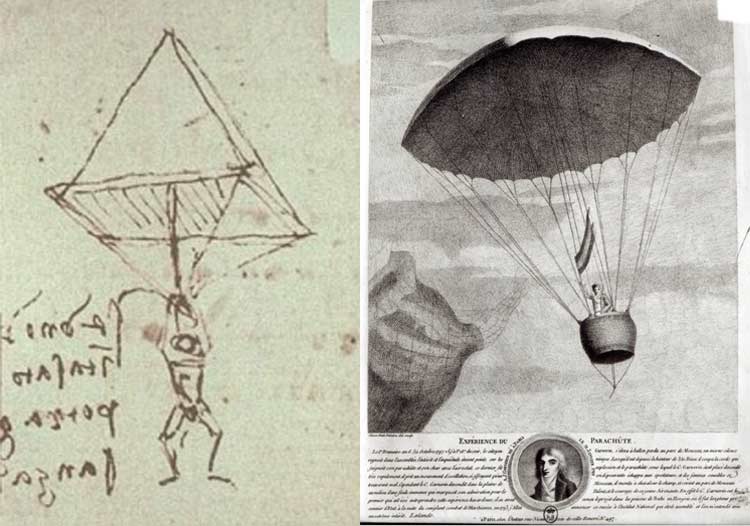
Left, Leonardo da Vinci’s design. Right, André-Jacques Garnerin’s balloon jump over Paris.
The bottom line:
Skydiving did not start as a tough stunt sport. It started as a technical problem: how do you get down from the sky in a controlled way, without the ground winning.
From early ideas and sketches to a balloon jump over Paris.
Then came the step to aircraft, training, and steerable parachutes.
And eventually the modern parachute system you use today, with multiple layers of safety.
- The idea behind parachutes is centuries old: slow a fall using air resistance
- 1797 was a turning point: Garnerin shows a human can jump from a balloon and survive
- Early 1900s shifts toward practical systems: backpack rigs, static line, and later jumps from airplanes
- From the 1960s onward, real steering becomes possible with ram-air (parafoil) parachutes
- Modern skydivers jump with a full system: cutaway, reserve, and often an AAD
Where did the idea of parachutes come from
Long before airplanes existed, people had one simple question: can you slow a fall without breaking yourself?
In old stories, and later in serious experiments, you see fabrics, frames, and “fall stoppers” appear.
Not as a sport, but as a survival idea.[1]
The principle is still the same today.
Increase the surface area above you, air resistance goes up, and your speed down goes down.
What started as a rough idea later became a technique, and eventually a complete sport.
Leonardo da Vinci and the first design on paper
Leonardo da Vinci drew a parachute-like design around the end of the fifteenth century: a pyramid shape with a person underneath, suspended by lines.
He never jumped it himself, but it shows how old the fascination really is.[2]
It was not “skydiving” as we mean it today, but it was the start of thinking in solutions.
Video: Leonardo’s parachute built and tested
Curious if the design actually works?
In this video you see a modern reconstruction and a test jump.
Modern test of a reconstruction of Leonardo’s design.
1797: the jump that changed everything
In 1797, André-Jacques Garnerin makes a jump from a balloon over Paris.
Not freefall like we know it today, but still a massive step forward: a human deliberately lets go, and arrives on the ground in one piece.[3]
That jump was rough and anything but comfortable.
But it proved the most important point: getting down from the sky in a controlled way is possible.
From that moment, parachute technology becomes something you can improve, test, and repeat.
From balloon to airplane: the start of modern parachuting
Once airplanes arrive, parachute technology suddenly becomes practical.
Not only for shows, but also as a lifesaving tool, and later for military applications.[1]
A key step is the idea of a parachute in a backpack that can open automatically via a static line.
It sounds simple, but it becomes the foundation of how many systems are built.
And then comes a moment you will recognize as “skydiving history”.
In 1912, a jump from an airplane is made that is often referenced as one of the first well documented parachute jumps from an aircraft.[4]
From there it accelerates, because what works once can be made safer, smarter, and repeatable.
- 1490s: Leonardo sketches a parachute idea
- 1797: Garnerin jumps from a balloon over Paris
- Early 1900s: backpack systems and static line make it practical
- 1912: jumps from airplanes enter the picture
- 1960s and 1970s: steerable ram-air parachutes transform the sport
From round parachutes to steerable ram-air canopies
If you really want to understand why skydiving feels so controlled today, remember one word: ram-air.
Instead of a round “umbrella”, you get a canopy with cells that inflate with air and starts flying like a wing.
That idea, the parafoil, was patented in the 1960s by Domina C. Jalbert and later became the foundation of sport parachutes as we know them.[5]
From that moment, landing changes from “coming down” to “flying in”.
And that creates room for training, precision, and disciplines like formation skydiving, freefly, and later wingsuit.
Safety becomes a system: cutaway, reserve, and AAD
The biggest shift in the sport is not only “a better parachute”, but thinking in layers.
Modern skydivers jump with a complete parachute system.
Not one piece of fabric you hope for, but a main canopy, a reserve, and a way to switch if needed.
That includes breakthroughs that truly changed the sport.
Think of hand-deploy pilot chutes, the 3-ring release (so a cutaway takes far less force), and later automatic activation devices (AADs) that can step in as a last safety net.[6][7]
If you want the jump from “fabric and rope” to modern systems crystal clear, read this one too:
Skydiving gear through the years.
What this means for you as a student
When you read this history, you see one clear line.
First it was survival. Then it became practical. Only after that did it become sport.
When you start learning to skydive, you step into that tradition.
Not as a stunt, but as a skill.
You learn step by step, with a system built on centuries of experimenting and decades of refining.
At Airboss, the focus is on training.
You start with structure, you build trust in the gear and in yourself, and you work toward your own licence.
If you want the first step explained clearly, read:
how to start skydiving.
And if you want a solid overview of training and regulations in the Netherlands:
parachute.nl (KNVvL).[8]
FAQ about the origins of skydiving
Is skydiving the same as parachuting?
Often, yes, in everyday language. Parachuting is the broader term. Skydiving is usually used for the sport side, focused on freefall and technique.
When was the first known parachute jump?
Garnerin’s jump in 1797 from a balloon above Paris is often seen as a major turning point in the history.[3]
When did parachutes become truly steerable?
The big leap came with ram-air (parafoil) canopies. They gave you a canopy that flies like a wing, making it genuinely steerable.[5]
What is the biggest safety breakthrough in modern skydiving?
Not one single thing, but the whole package: a low-force cutaway system, a reliable reserve, and for many jumpers an AAD as a last-resort safety net.[7]
More inspiration for starting skydiving
- ➔ Your first skydive: what to expect from that very first jump.
- ➔ Misconceptions about skydiving: which myths are persistent, and what is actually true.
- ➔ Is skydiving dangerous: about risk, perception, and what really holds up.
Sources and further reading
- [1]
Encyclopaedia Britannica: Parachute (history and development) - [2]
Wikipedia: Leonardo’s parachute (design and context) - [3]
FAI: 1797, Garnerin and the first modern parachute jump - [4]
Smithsonian: Albert Berry and the airplane jump (1912) - [5]
International Skydiving Museum: Domina C. Jalbert and the Para-Foil (ram-air / multi-cell canopy) - [6]
USPA: a look back at the evolution of sport gear (including piggyback rigs, throw-out pilot chute, 3-ring) - [7]
FAA Parachute Rigger Handbook: basics and systems (including AAD) - [8]
KNVvL Parachuting (parachute.nl): training, licences, and regulations in NL
You are not only stepping out of an airplane. You are stepping into a story that has been evolving for centuries, and you get to write the next chapter.