




The psychology of freefall:
what happens in your brain when you skydive?
Last updated: 9 December 2025
The bottom line:
During a skydive your brain switches rapidly between stress, focus and reward. In this blog you will read what happens in your head and body, from the adrenaline kick at exit to the mental clarity in freefall. We zoom in on the psychology of skydiving and show how the experience can, over time, contribute to resilience, mindfulness and personal growth.
- Skydiving activates a powerful mix of adrenaline, dopamine and serotonin and you feel that immediately in your body.
- During freefall you experience maximum focus, calm and a clear head, similar to mindfulness.
- In the long run, skydiving can boost mental resilience, self-awareness and personal growth.
Your first seconds: pure alertness
The moment you step out of the plane, a lot happens in your brain. Your body switches into the well-known fight-or-flight mode: your heart rate goes up, your senses sharpen and your focus narrows. This is not panic, but a natural state of alertness. The hormone adrenaline is released to prepare your body for action, with a feeling of strength and clarity as a result.
As an instructor I see those first seconds every day in the faces of students. Wide eyes, tension, but also something else: total presence. You are nowhere else but here, now, in this jump.
From stress to reward
Once those first seconds have passed, another process takes over. Your brain rewards your courage. The neurotransmitters dopamine and serotonin are released and give you that feeling of euphoria, calm and satisfaction after the jump. This is what skydivers often describe as the skydiver’s high: a unique mix of relief, pride and pure happiness.
That reward system becomes even stronger when you have just crossed a big threshold. You were literally standing in the door, everything in your body was screaming “wait”, and you went anyway. Your brain stores that moment as proof that you can do more than you thought.
A clear mind, in the best possible way
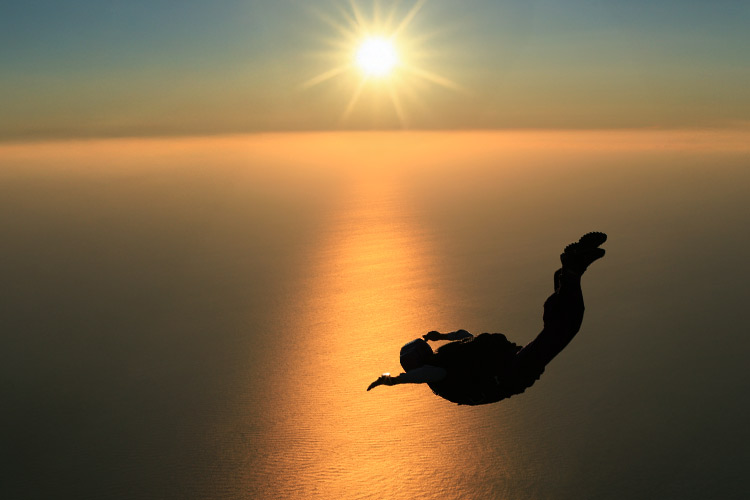
During freefall there is no room for noise. No to-do list, no worrying thoughts, no distractions. Everything is now. Your sense of time changes, your senses synchronise and you experience each moment with maximum intensity. This heightened awareness is the reason many people keep coming back to jump again.
Long-term effects: more than an adrenaline kick
Regular skydiving can lead to lasting psychological benefits. Research shows that experienced skydivers cope better with stress and recover more quickly from stressful situations. They develop higher resilience and a stronger sense of control over their emotions. The more often you jump, the more natural that process becomes. Your body and mind learn to deal with it, which deepens the effect. (source)
In practice I often hear the same sentences after a course. “If I can do this, I can handle that conversation with my manager as well.” Or: “Since that week in Royan, my everyday stress feels much smaller.” That is the psychology of skydiving outside the dropzone: the confidence you carry into the rest of your life.
Want to read more about how to work with tension around your jump? Then also check out the blog Skydiving and stress.
Mindfulness in the air
During freefall you are completely in the moment. All distractions disappear and your focus is purely on the here and now. This state of heightened awareness can lead to a feeling of mindfulness, similar to meditation. (source)
For many people this is a surprise. They expect chaos and overload, but instead experience space and quiet. As if someone presses pause in your head while everything around you is running at one hundred percent.
More than technique: the psychology of skydiving
Skydiving is not just a trick. It is an experience that opens your mind and changes your perspective. You discover how you deal with tension, what your body can handle and how powerful it is to trust yourself. That is why skydiving is not only exciting, but often healing as well.
During an AFF course or a pathway towards your A licence you work every day on that combination of technique and mindset. You learn a stable exit, altitude checks and landings, but you are just as much training your ability to stay calm under pressure and make conscious decisions.
Ready to experience what happens in your own head?
Do you want to learn skydiving not only technically, but also consciously experience what happens mentally? Then the Ground Control Skydive & Mindfulness Retreat might be for you. In Royan we combine jumps with reflection, coaching and mindfulness, for an experience that goes much deeper than adrenaline alone.
More inspiration on the mental side of skydiving
- ➔ Skydiving and stress: how your mind works in the air.
- ➔ Skydiving with fear of heights: is it possible?
- ➔ Your first skydive: from hurdle to euphoria.
Curious about skydiving, training or skydive holidays?
Visit our Airboss homepage to discover all options.
“The freefall only lasts half a minute, but what happens in your mind stays with you for life.”