




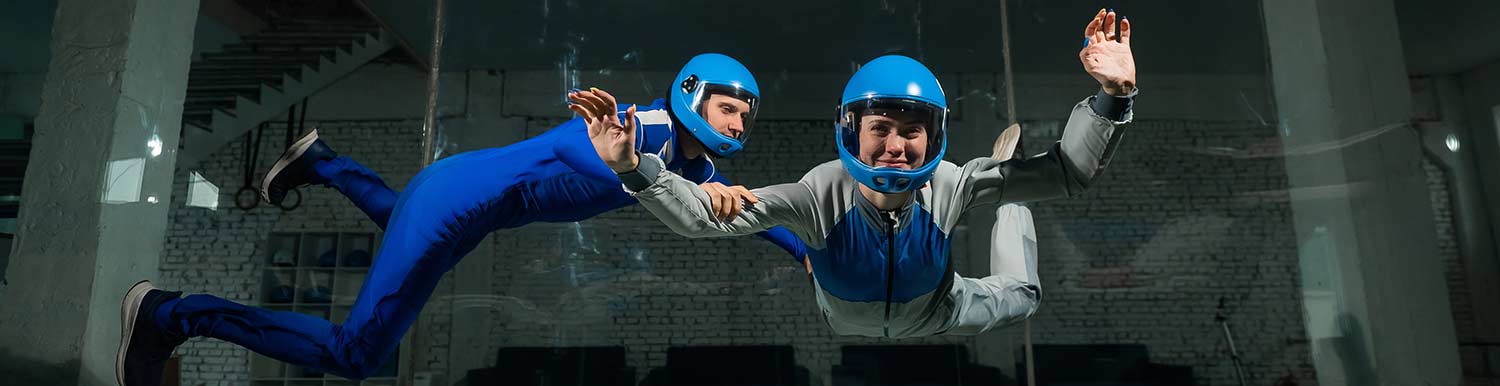
Indoor skydiving:
why a wind tunnel is the perfect
preparation for your AFF course
Last updated: 13 March 2026
The bottom line:
With wind tunnel skydiving (indoor skydiving) you can already learn how to fly before jumping out of an airplane. You get used to the airflow, learn the basic body position and understand much faster what happens during your first jumps in the AFF course.
- In a wind tunnel you experience the feeling of flying without an airplane.
- Your body learns a stable freefall position much faster.
- Your first jumps during the AFF course become calmer and more productive.
What does flying without a parachute feel like?
Many people who think about skydiving ask themselves one question: what does it actually feel like to fly?
Today you can already experience that feeling without jumping out of an airplane. In a wind tunnel you lie in a powerful column of air that supports your body. It feels as if you are floating. In reality you are flying, without a parachute and without an airplane.
For beginner skydivers this is an ideal preparation. Your body starts to understand how the airflow reacts to small movements of your arms and legs.
In the past, learning to skydive mainly meant jumping and figuring things out along the way. That worked, but you only had about thirty seconds per jump to try something new.
By spending time in a wind tunnel first, you start your first jumps during the AFF course with a clear advantage.
What is a wind tunnel (indoor skydiving)?
A wind tunnel is a vertical tube in which a powerful stream of air is blown upward. This airflow keeps your body balanced, just like during a real freefall.
Many people know this as indoor skydiving. You experience the sensation of freefall without having to jump from an airplane.
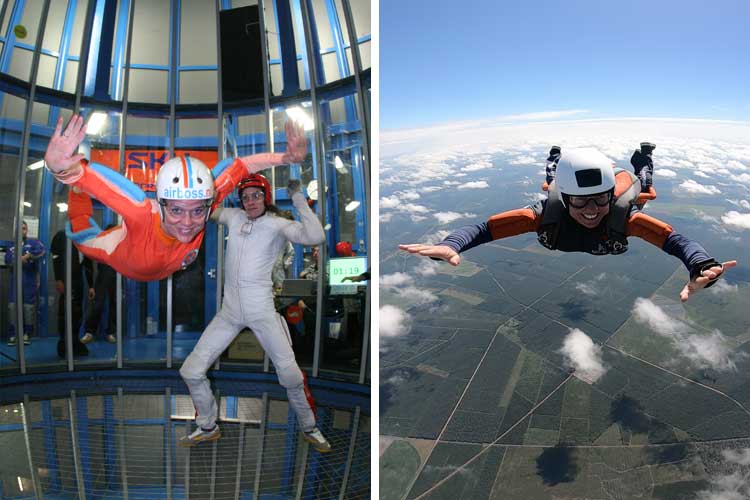
The airflow in the wind tunnel replicates the feeling of freefall.
For beginner skydivers the wind tunnel works like a flying laboratory. You can calmly get used to flying, turning and correcting your position without having to think about altitude, parachute deployment or landing.
Why practicing in a wind tunnel helps
You get used to the feeling of freefall
The first freefall is not only mentally exciting. Your body also needs time to adapt to the airflow. If you already know that feeling from the tunnel, your first jump feels far less overwhelming.
You receive direct feedback
In a wind tunnel the instructor is literally right next to you. With hand signals and guidance you can immediately improve your body position.
You learn a stable body position faster
A stable freefall position forms the foundation of your first jumps. In the tunnel you can accumulate many minutes of flight time in a short period.
You build confidence
The moment you notice your body starting to understand the airflow, you relax. The excitement remains, but you know the feeling already.
You are allowed to make mistakes
In the wind tunnel you can turn, correct and try again without altitude or landing playing a role. Mistakes simply become part of the learning process.
The sport is evolving
Skydiving has developed enormously over the past years. Where beginners once mainly learned through experience in the air, today you can train many skills before ever stepping into an airplane.
You see the same among experienced teams. They often spend hours training in wind tunnels to refine their freefall skills. As a beginner you can use that same method to start your skydiving journey with a strong foundation.
Of course you can learn to skydive perfectly well without wind tunnel experience. It is not a mandatory part of the training. But it does help you approach your first jumps with more calm and control.
Where can you go indoor skydiving?
In the Netherlands you can go to:
In Belgium there are tunnels in:
Tip: when booking, mention that you plan to take an AFF course. Instructors can then give exercises that match your first skydives.
Ready to learn how to fly?
Practicing in a wind tunnel is not a must, but it can be a smart preparation. Especially if you want to step into the airplane with more confidence and control.
The AFF course from Airboss is the logical next step.
More inspiration about skydiving
- ➔ Your first skydive: from hesitation to euphoria
- ➔ 5 misconceptions about skydiving: what beginners often expect incorrectly
- ➔ How to start skydiving: the first step toward your AFF course
On our homepage you can find all courses and destinations in one place.
“The wind tunnel gave me calm. When I finally jumped, my body already knew what to do.”